


Hi, glad you are here! Each week, we share founder stories about building efficient go to market systems, common founder missteps, and tips for accelerating revenue growth as you build your start-up.
Open LinkedIn this week and you will find a hundred posts about AI-native architecture in startups. The stat I see people quoting is “revenue per employee”. According to the Forbes article from March, AI-native companies are hitting $2 million to $4 million per employee. The average public SaaS company is sitting at $300,000. That gap is real, and it is getting wider every quarter.
Founders are reading that stat and hearing one thing: add AI agents. IMPO, that is the wrong lesson.
The companies putting up those numbers did not get there by bolting a chatbot onto their CRM. They got there because the architecture underneath the agents was already sound. The agents are not the reason for the efficiency. They are what becomes possible once the efficiency already exists.
Most founders are building it backwards.
AI does not fix bad data. It scales it.
If you are new here, this is is my 2026 mantra. If your CRM data is a mess, if ownership of fields is unclear, if your process for handing a deal from SDR to AE to CSM lives in someone’s head instead of a system, AI does not clean any of that up. It moves faster than a human ever could through exactly those same problems. Period.
RevOps teams already know this, but founders may not be aware of the danger that lies ahead if done improperly. Survey data from earlier this year shows nearly half of operations teams plan to expand AI use across their GTM workflows in the next twelve months. But the majority are still stuck in the easiest use case available. Enrichment. That is the one place the data is clean enough to trust an agent with it. Everything else, the real revenue-driving workflows like routing, forecasting, full-cycle opportunity management, stays untouched. Not because the AI cannot do it. Because the foundation underneath it cannot be trusted with it yet.
This is not a tooling gap (turns on in my sweet southern voice) “Honey, you have a GTM debt problem.”
AI-native is a debt decision, not a tooling decision
I have said this before in a different context. GTM Debt does not show up as one big collapse. It shows up as compounding drag. Every workaround, every undocumented handoff, every field nobody owns, it all sits there quietly until something forces you to look at it.
AI is that something.
You cannot layer agents onto a system that already has debt in ownership, data, or process. You are not automating your GTM motion at that point. You are automating the debt. And debt that runs on autopilot does not stay the same size. It grows.
This is where the conversation about “AI-native architecture” actually lives, if you strip out the venture capital framing. It is not about headcount. It is about whether the layer underneath your automation can hold the weight you are about to put on it.
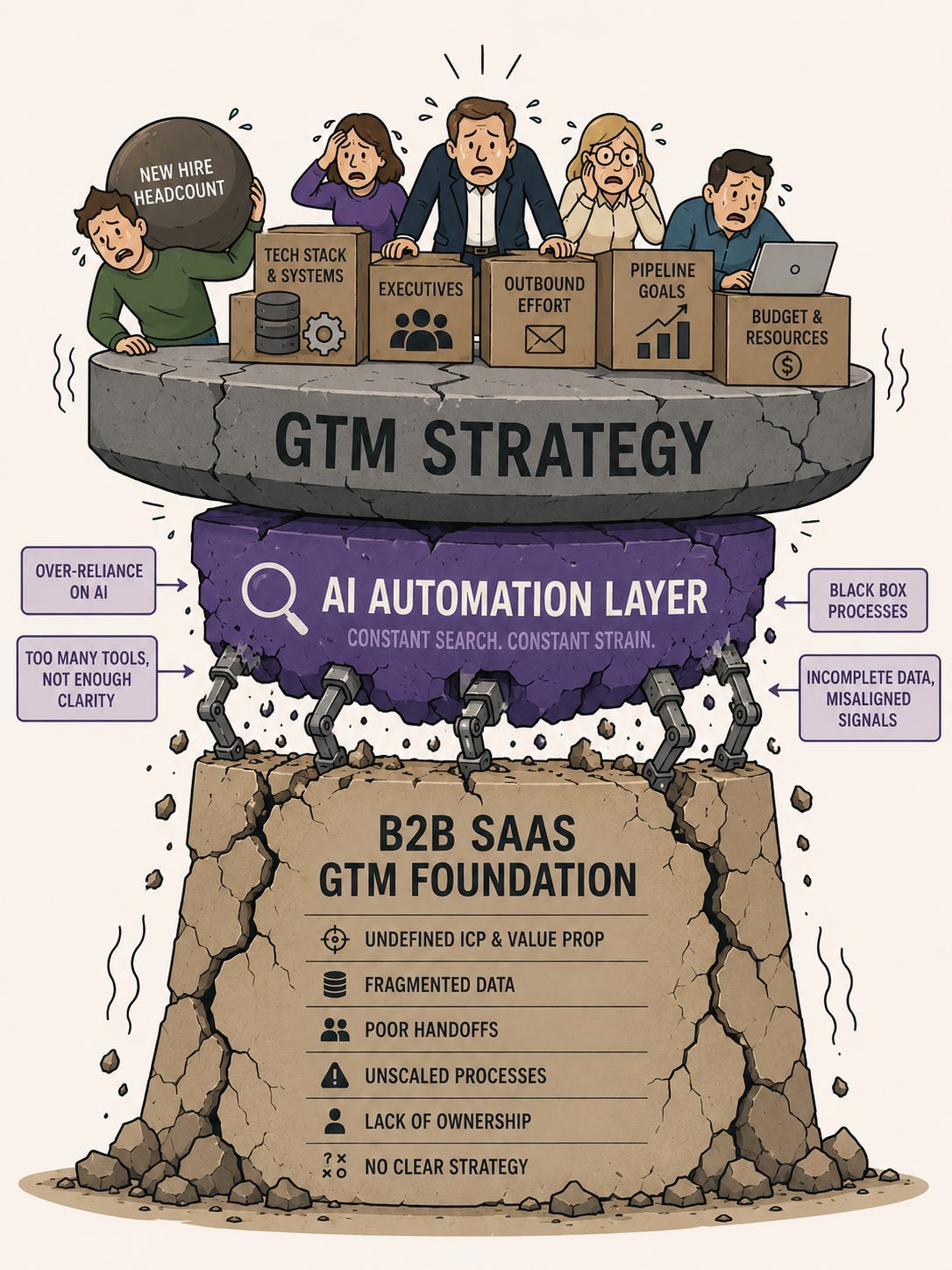
Pro-tip: Try running AI as your data police by connecting your CRM and creating a field audit. I’ve included a full prompt and example at the end of this article.
What “architecture” actually means
Not a stack of tools or a longer list of integrations. Architecture is a short list of things that have to be true before an agent gets trusted with anything revenue-critical.
A single source of truth per data object. If your CRM, your marketing automation platform, and your data warehouse all have a different answer for who owns an account, an agent will pick one and be confidently wrong.
A documented handoff process. SDR to AE. AE to CSM. If that process lives in tribal knowledge, there is nothing for an agent to learn from, and nothing to hold it accountable to.
A defined scope of autonomy. What can an agent touch without a human checking it first. What requires a human in the loop no matter what. Enrichment and routing are not the same risk level as a customer-facing renewal conversation. Treat them differently.
A feedback loop that actually gets used. Not one you built and forgot about. One where corrections flow back into the system and the system gets measurably better because of it.
None of this is exciting (maybe to us RevOps folks). It will not get you a headline about revenue per employee. But it is the difference between a company that AI makes faster and a company that AI makes faster at being wrong.
The ten second test
Here is a gut check you can run today. Pick a core object in your CRM. A lead, an opportunity, an account. Ask yourself who owns that field and why.
If you cannot answer in under ten seconds, you are not ready to put an agent in that workflow. Not because the technology is not there. Because you do not yet have a system an agent can be trusted to learn from.
This is not a reason to panic. It is a reason to sequence correctly. Fix the ownership question first. The automation gets easier, not harder, once you do.
Find the full CRM audit prompt at the bottom of this article
Steelmanning the other side
I want to pressure test this before I ask you to believe it, because the loudest data out there right now cuts the other way.
The headline stat everyone is quoting is revenue per employee. AI-native firms posting $2 million to $4 million in revenue per employee, against $300,000 for the average public SaaS company. Cursor is reportedly running near $40 million per employee. Midjourney is around $12.5 million per employee on forty people, with zero outside funding. Read fast, that stat says architecture does not matter. Just add AI and watch the ratio move. Its magic!
No magic. Here is the problem with that read. Those are three or four companies. They get written about constantly because they are outliers, not because they are representative. Nobody is publishing a case study on the AI-native startup that raised a seed round, hired six people, bolted on some agents, and quietly died at $200,000 in revenue. Survivorship bias is doing a lot of work in that stat, and it is worth saying so before anyone builds a strategy on it.
There is a second, more serious counterargument, and it does not come from skeptics. It comes from operators who would agree with most of what I just wrote and still push back on the sequencing. Their argument is that heavy governance up front is exactly how you kill the speed advantage AI is supposed to give you. Restrictive controls do not stop teams from building. Teams just route around them. The lightweight version of this argument, and I think it is a fair one, is that you do not need a fully governed system before you touch an agent. You need just enough structure to keep moving without creating chaos. Fix the two or three things that would actually break something, and let everything else stay flexible until it has to change. That is a real tension with what I wrote above, and founders who read GTM Debt language as “build a compliance function before you ship anything” are reading it wrong.
There is a third data point that cuts against the AI-native optimism entirely, and it is the one I take most seriously. MIT’s NANDA initiative looked at 300 public AI deployments and 150 leadership interviews and found that roughly 95 percent of generative AI pilots fail to produce measurable impact on the P&L (damn). The reason was not the model. It was almost always a learning gap, tools that never adapt to the actual workflow they were dropped into, and most of the budget going to sales and marketing use cases when the real returns were sitting in back office automation the whole time. That stat is not an argument against my thesis. It is the data behind it. But it has real critics too. The methodology relied on a narrow six month P&L window and about fifty interviews the report itself called directionally accurate rather than definitive. If you are going to use the 95 percent number in a room, know that someone might push back on it, and have an answer ready.
So where does that leave the argument. I think the honest version is this. The revenue per employee stat is real but it is describing a handful of extreme outliers, not a repeatable playbook. The lightweight governance argument is a legitimate check on over-engineering, and it should keep anyone, including me, from turning “fix your foundation” into “build a bureaucracy before you ship.” And the 95 percent failure stat, contested methodology aside, is still the closest thing we have to evidence that most companies are automating on top of debt rather than fixing it first. All three of those can be true at once. The takeaway is not “ignore the foundation.” It is “build only the foundation that actually prevents a failure, and stop there.”
The fix is not more AI. It is less debt.
Do you agree? If you want an honest read on where your GTM debt actually sits before you start automating around it, the assessment takes five minutes: gtmscore.ai
Hi! I’m Laura Wheeler is Co-Founder and COO of RVNU, a B2B SaaS go-to-market advisory firm. We built RVNU to help founders measure and pay down GTM Debt, the accumulated misalignments between go-to-market strategy and execution that quietly throttle growth.
CRM Field Audit directions + prompt:
Connect your CRM to Claude. (If that isn’t possible, you can export all object fields and information as a CSV)
Use this prompt: I need to do an audit to help optimize my CRM for stadardization, reporting, insights and AI. The audit includes the Company/Account, Contact, Lead and Opportunity/Deal objects.
This audit consists of field mapping per each Object. Please pull from the [CRM connected or see attached export] and pull adudit findings into a google/excel sheet (one field per row, each object is a tab) with the following:
Field name
Field Type (picklist, text, number, etc)Is this a native CRM field or custom created
Whether the field is a Manual entry or calculated based on conditinal logic
Field Description (leave blank if blank)
Field dependencies - What reports, dashboards or
Who created the field
Usage % (what is the fill rate)Once we have a clear view of the fields by Object, I need you to identify
1. potential duplicate fields (State abbr. vs State code)
2. fields that do not have definitions
3. fields with less than 10% filled information4. fields where there is field type mis match (example: website domain is set to free form text instead of a URL).
Please color code each 1-4 above for identification per each for me to review. Output will look something like this.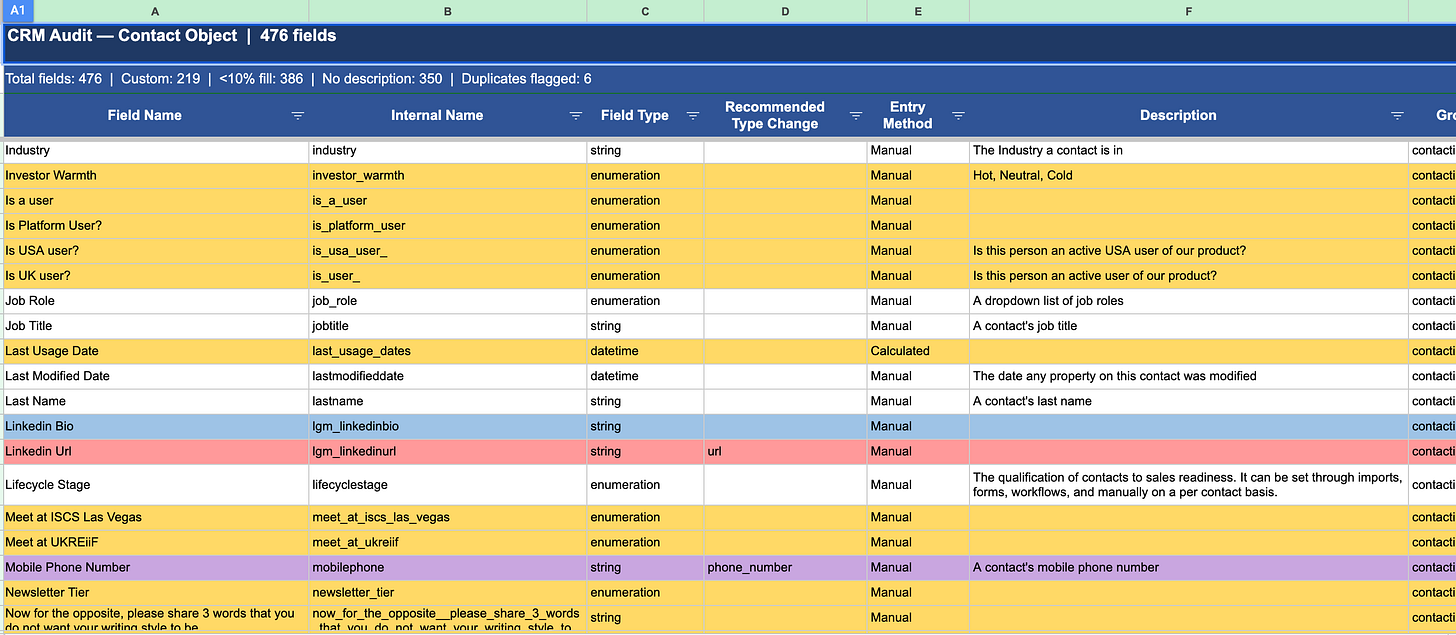
Do a human review (always a human review, PLEASE)
Then you can take that final list and take action on the necessary gaps.
Ensure that everyone is onboard and use it as a taxonomy dictionary for everyone to reference.
Did someone say - free “GTM field CRM audit prompt”? See article and test it yourself!