
RVNU #059: The $200K Shadow Tax: What Founders Get Wrong About Onboarding
Spoiler: Your new hire watching sales calls isn't learning your system—they're inventing their own

Let me tell you about the most expensive two words in early-stage B2B SaaS new hire onboarding:
“Call shadowing.”
As in: “Hey, welcome aboard! We are going to get you access to the CRM, listen to some calls, and you’ll pick it up.”
I’ve been in GTM for 16 years and I can tell you with absolute certainty:
“Just shadow a rep” is founder-speak for “I have no idea how to transfer what’s in my head to someone else.”
And the cost of getting it wrong? 1.5-2x their annual salary, 6 months of lost ramp time, 40% higher rep churn, and a sales org where everyone sells differently because no one actually knows what “good” looks like.
In this newsletter I’ll break down what’s actually happening and how you can fix or get ahead of it.
The Pattern Every Founder Follows (And Why It Fails)
So you are ready to hire some reps? Here’s the script I hear on repeat:
Founder: “We just hired our first real AE! She’s got 10 years of experience, closed deals at [impressive company/industry competitor], and she’s ready to crush it.”
Me: “Amazing. What’s your onboarding plan?”
Founder: “Well, we’re going to get her set up with email, Slack, CRM access. Then she’ll shadow me and [other rep] for a week or two. Then she will be ready.”
Me: “What happens after she shadows?”
Founder: “She starts taking calls, obviously. She has a ton of prior people in her network to call. We need pipeline.”
Me: “Okay. What does she need to know before she takes those calls?”
Long pause.
Founder: “Like... the product?”
No. Not like the product.
Here’s what actually needs to happen before that rep picks up the phone:
Week One Is Not About Your Product (And That’s The Point)
When I started at Tableau in 2013, new hire onboarding was a two-week in-person bootcamp at our HQ in Seattle.

[Image: Laura Wheeler and Meredith Hightower in March 2013 Tableau Bootcamp]
One of the first sessions we attended was “Tableau University”, where then CEO, Christian Chabot, stood up in front of the group to teach us about Tableau. He entered the room and asked…. Do you know what we sell here at Tableau?
New Hire (confidently raises hand): Data visualization software.
Christian: No.
You could hear the new hire group murmuring and confused and after a long - intentional - pause
Christian: We sell time.
And here’s what shocked me - the next 2 hours of “Tableau University”, we didn’t touch the product. It was a 2 hour deep dive into the hypothesis upon which Tableau the product was built.
The history of data and art of visualization
What is business intelligence software and who cares about it?
What is that “someone” currently using and why is status quo so hard?
What’s the competitive landscape and why Tableau?
What does their day look like before Tableau vs. after?
By the end of the first week, we could recite (and also feel) the problem Tableau was solving as if we were the customer. We understood their pain in their language. You knew what mattered to them and why before you ever saw a product demo.
That’s the foundation. Product features are useless if you don’t know who they’re for and what problem they solve.
But here’s what most startup founders do instead:
Day 1: “Let me show you the product! Here’s every feature we’ve built. Isn’t it cool?”
Day 2: “Here’s the deck. Go shadow some calls.”
Day 3: “You’re smart, you’ll figure it out. We need you ramping fast.”
Then three months later: “Why is she chasing deals that will never close? Why is her discovery so surface-level? Why does every deal take 2x longer than when I run it?”
Because you never taught her the foundation. You just showed her the product and hoped she’d reverse-engineer your entire GTM strategy by osmosis.
The Three Categories That Actually Matter
If you’ve gone through the RVNU framework, as you build left to right you’ve researched and hypothesized in Idea Market Fit. Aligned strategically to prove Product Market Fit and (funny enough) it’s the exact structure your onboarding plan needs.
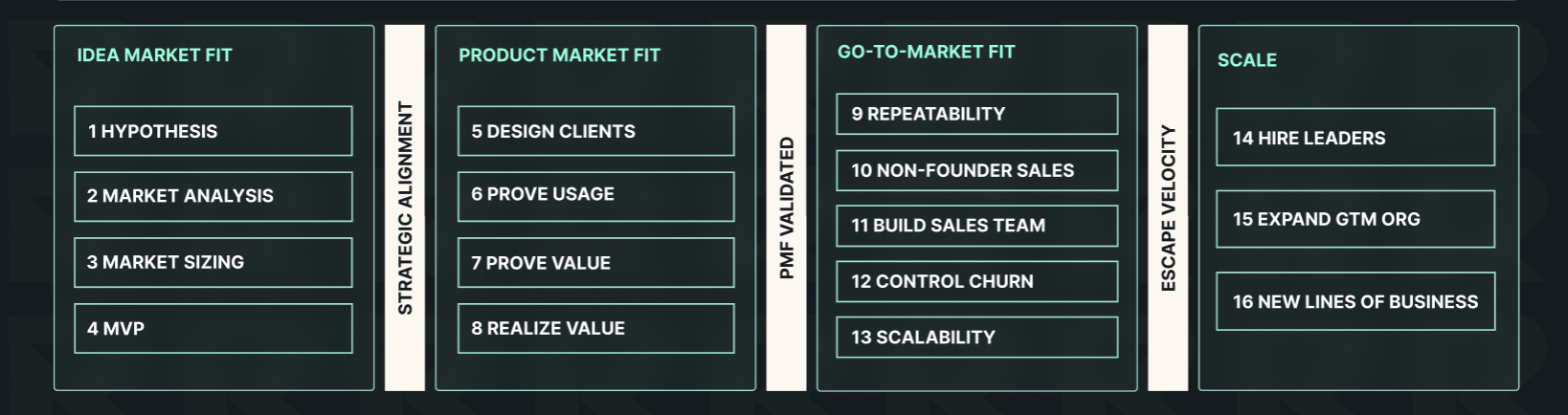
Here’s what every new GTM hire needs to master before they talk to prospects:
1. Hypothesis & Problem Landscape
What problem are we solving and for whom? Not in product-speak. In customer-speak.
Your rep needs to be able to explain the problem and the pains of staying in status quo. They need to be finding and talking to people about the problem where the prospect says: “holy shit, are you reading my mind?”
If they can’t do that, they’re going to pitch features. And features don’t close deals. Understood problems close deals.
2. ICP & Competitive Landscape
Ideal Customer Profile: Who actually buys this product? What do they look like? What titles? What company size? What tech stack? What pain threshold?
And critically: Who doesn’t buy? What disqualifies someone in the first 90 seconds?
I’ve watched reps waste entire quarters chasing “strategic opportunities” that were never ICP fit because no one taught them how to identify bad fits early.
Plus: Who are we competing against? Not just direct competitors—what’s the status quo? What are prospects using today? Why would they switch?
One of my favorite onboarding exercises: Give new hires a list of 20 companies or people profiles and have them score ICP fit based on publicly available data. No product pitch. Just: Is this someone we should be talking to? Why or why not?
3. Unique Value Proposition & MVP
Finally—FINALLY—we get to the product. But not a feature tour. A value proposition.
What does this product do? What outcomes does it create? What’s the benefit to the ICP?
Notice the order: We understand the problem, we know who has it, we’ve sized the pain its causing you, and NOW we show how we solve it.
That’s how buyers think. That’s how your reps should sell.
What Happens When You Skip This
Let me paint you a picture of what “just shadow a rep” actually creates:
Month 1: New hire is enthusiastic, taking tons of notes, sitting in on your calls. They think they’re learning.
Month 2: They start taking their own calls. Pitch is all over the place. They’re mentioning features you don’t have. They’re chasing prospects who will never buy. But they’re active, building “pipeline” so you think it’s working.
Month 3: You start hearing things in their calls that make you cringe. Wrong positioning. Bad discovery. Pricing conversations that go sideways. You jump in to “help close” the big ones.
Month 4-6: Their close rate is 40% lower than yours. Their deals take twice as long. They’re frustrated. You’re frustrated. You start wondering if you made a bad hire.
Month 7: They quit or you let them go. You’re back to doing it all yourself. You’ve lost 6 months and $180K+ (salary + benefits + opportunity cost).
And here’s the kicker: It wasn’t a bad hire. It was a bad onboarding.
You hired someone with talent and experience, then gave them zero structure to succeed in your specific motion.
The Accountability Trap
So let’s say you DO have an onboarding plan (yay!), so why do so many companies stop there. Its not a checkbox exercise. If you have no onboarding milestones, feedback or iteration its dead as soon as you built it.
In a proper onboarding plan, there are clear checkpoints & milestones:
Milestone 1: Can they identify ICP fit from a cold intro? Can they articulate our top 3 value props in customer language? Can they explain our competitive positioning?
Milestone 2: Can they run discovery using our framework? Can they ask the questions that reveal real urgency vs. tire-kicking? Can they handle the top 5 objections?
Milestone 3: Can they present a demo that’s tied to discovery findings? Can they navigate a pricing conversation without freelancing? Can they multi-thread within an account?
Milestone 4: Can they do all of the above in live prospect conversations with you observing?
If you don’t have these, you have no idea if your rep is ready. You’re just hoping. And hope is expensive.
One client implemented this framework and cut their time-to-first-deal from 120 days to 60 days. Same quality of hire. Different structure. That’s a 2x ramp improvement just from having a documented plan with accountability milestones.
“But Laura, We’re Too Early For This”
No. You’re not.
I hear this all the time: “We’re only hiring our first AE. We don’t need a formal program yet.”
Wrong.
You need a plan (not a program—there’s a difference) from the moment you hire your first GTM person.
Here’s why: That first hire is your template. Whatever works or doesn’t work with them becomes your baseline. If you wing it, you’re building your entire future sales org on top of a shaky foundation.
A plan is simple:
What do they need to learn?
In what order?
How do we know they’ve learned it?
What’s the timeline?
That’s it. Document it. Version it. Iterate it with every hire.
By the time you’re hiring rep #5, you should have a plug-and-play onboarding plan that takes what’s in your head and systematically transfers it to everyone who touches revenue.
The Living Document Approach
Here’s the thing about onboarding: It’s never done.
Your ICP evolves. Your product changes. Your competitive landscape shifts. Your value prop gets refined based on what’s actually resonating.
If you onboarded someone a year ago and they haven’t revisited the material, they’re selling an outdated version of your company.
That’s why onboarding needs to be a living document:
Every time you hire someone new: Have them go through the plan. Collect their feedback. What was confusing? What was missing? What helped them ramp faster?
Every time something major changes: Update onboarding. New ICP? Update week one. New competitor? Update the competitive section. New positioning? Update the value prop training.
Every year: Once you have more than 4 reps selling (greater than a year in the business), this is when true enablement comes into play. Onboarding becomes evergreen learning. Taking the signals from within the business and training people to become more efficient sellers.
💡Pro Tip: One startup I worked with does quarterly “onboarding refreshers” with the whole team. 2 hours. Everyone goes back through the core material. Keeps the entire team aligned as the company evolves.
That’s how you prevent drift. That’s how you keep everyone selling the same way.
The GTM Debt You’re Accumulating
Here’s what most founders don’t realize: Every rep you onboard without a system is accumulating GTM Debt.
Rep #1 learns by shadowing you. They pick up 60% of what’s in your head.
Rep #2 learns by shadowing Rep #1. They pick up 60% of what Rep #1 knows. (That’s 36% of what you know.)
Rep #3 learns from Rep #2. Now we’re at 22% of your original knowledge.
By rep #3, you’ve lost 78% of your GTM motion to broken telephone.
And now you have three reps selling three different ways, and you’re wondering why nothing is predictable.
That’s GTM Debt. And it compounds faster than you can fix it.
So What Do You Actually Do?
If you’re reading this and thinking “we don’t have an onboarding plan,” here’s your action plan:
Step 1: Stop telling new hires to “just shadow.”
Seriously. Immediately. That’s not onboarding.
Step 2: Document the four categories.
Take everything in your Idea Market Fit phase and turn it into training modules:
Hypothesis/Problem statement
ICP definition & competitive landscape
Unique Value Proposition
MVP & technical acumen
Step 3: Add accountability milestones.
For each week of onboarding, define:
What they’re learning
How they’ll prove they learned it (assessment, role-play, live observation)
What “ready for next week” looks like
Step 4: Collect feedback and iterate.
After each new hire completes onboarding, ask:
What worked?
What was confusing?
What would you add or change?
Use that to version your plan. By rep #5, you should have something really tight.
Step 5: Make it a living document.
When your ICP evolves, update the onboarding. When your product changes, update the training. When someone finds a better way to explain your value prop, add it to the plan.
This isn’t a “set it and forget it” thing. This is your GTM operating system.
Want To Know Where You Actually Are?
Look, I get it. You’re moving fast. You’ve got 47 things on your plate. Building an onboarding plan feels like something you’ll get to “next quarter.”
But here’s the thing: Every day you wait is another day your reps are out there making it up as they go. Another day of inconsistent messaging. Another day of GTM Debt compounding.
Lucky you - we’ve helped build simple AND comprehensive onboarding plans for our paid clients derived directly from our RVNU framework elements. Our GTM Debt Assessment that shows you exactly whats missing and what you need to build to pull it all together.
That GTM debt is costing you 6 months of ramp time per hire so take the GTM Debt Assessment and get your results today: https://form.jotform.com/240848153279060
Happy building, folks!
Drop a comment: What’s the worst onboarding (or lack thereof) you’ve ever experienced? What would you have changed?
👏👏
The broken telephone metaphor really nails it, by rep #3 you're down to 22% fidelity and wondering why everyones pitch sounds different. I've seen this play out at a cople startups where the 'just listen to calls and figure it out' approach created this weird franken-methodology that nobody could articulate. That accountability milestone framework is gonna save people a ton of pain.